
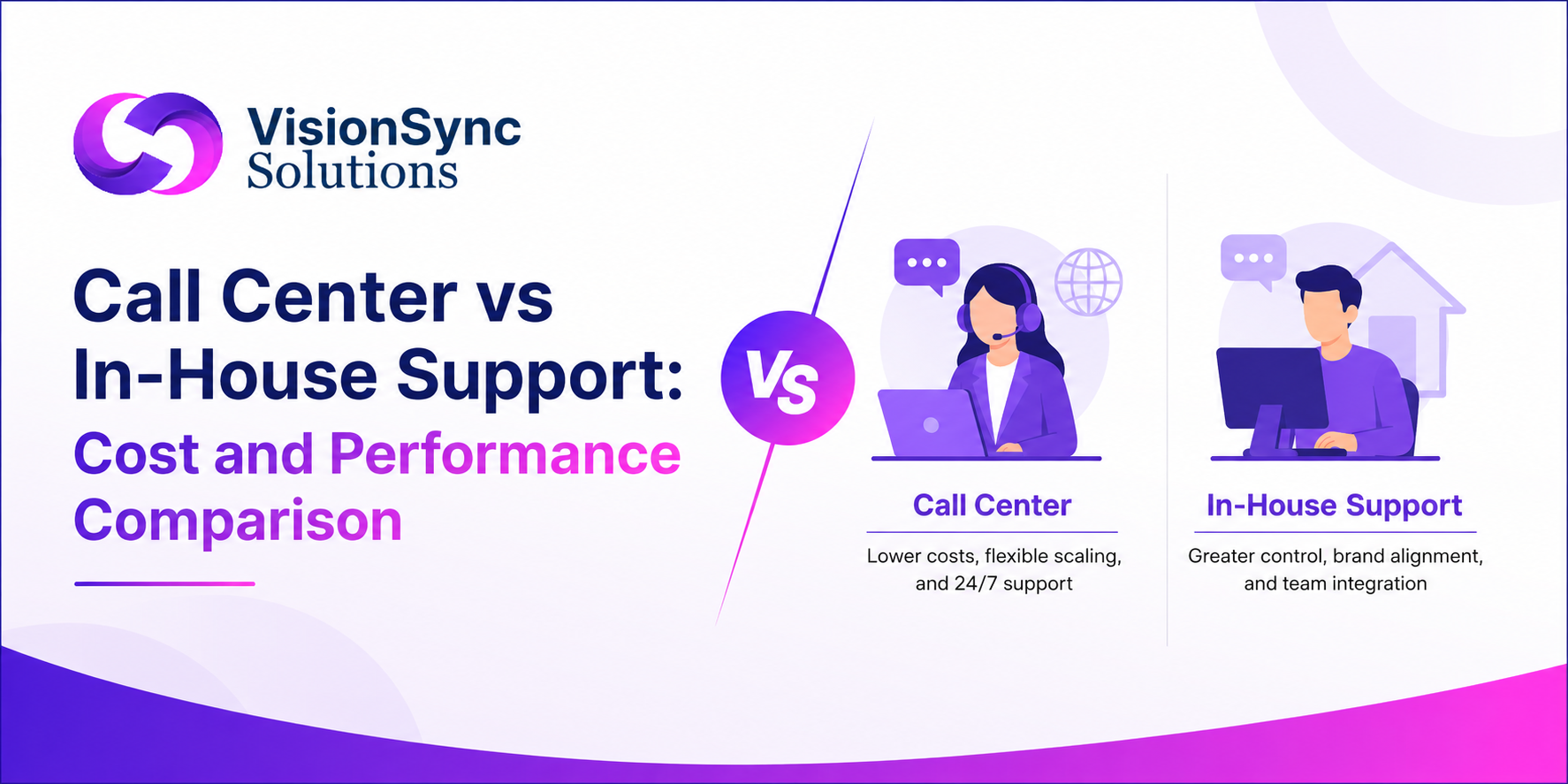
When Customer Support Starts Slowing Business Growth
A growing healthcare company in Denver faced a difficult operational decision. Customer inquiries had doubled within a year, response times were slipping, and internal staff were overwhelmed handling calls, scheduling, and follow-ups. Leadership considered hiring a larger in-house support team, but rising payroll costs, turnover, and training delays made scaling internally expensive and unpredictable.
At the same time, outsourcing customer support to a specialized call center raised concerns about quality control, customer experience, and brand consistency.
This is a challenge many small and medium-sized businesses (SMBs) face today. As customer expectations rise, companies must balance operational costs with service quality. Choosing between an in-house support team and an outsourced call center is no longer simply a staffing decision-it is a long-term operational strategy.
Understanding the Difference Between In-House and Outsourced Support
In-House Support Teams
An internal support team operates directly within the business, often handling customer communication, technical support, scheduling, and issue resolution internally.
Common Advantages
- Greater direct oversight
- Stronger internal culture alignment
- Immediate collaboration with other departments
Common Challenges
- Higher operational costs
- Recruitment and retention pressure
- Limited scalability during growth spikes
Outsourced Call Centers
Third-party support providers manage customer communication remotely using dedicated agents, technology platforms, and operational workflows.
Common Advantages
- Lower infrastructure costs
- Faster scalability
- Access to trained support professionals
- Extended or 24/7 coverage availability
Common Challenges
- Initial onboarding complexity
- Need for structured quality monitoring
- Potential communication inconsistencies without strong SOPs
Cost Analysis: Which Model Is More Affordable?
For many SMBs, cost becomes the primary deciding factor.
In-House Support Costs Typically Include:
- Salaries and benefits
- Office infrastructure
- Recruitment expenses
- Training and onboarding
- Software licensing
- Employee turnover costs
Industry research shows that replacing a single customer support employee can cost thousands annually when hiring, training, and lost productivity are considered.
Outsourced Call Center Costs Typically Include:
- Fixed or scalable monthly service fees
- Shared infrastructure models
- Pre-trained staffing resources
- Existing management systems
- Performance reporting tools
Businesses outsourcing support operations often reduce operational costs by 30%–50%, particularly when scaling customer service across multiple time zones or locations.
Performance Metrics That Matter
Response Times
Outsourced support providers often deliver faster response handling because operations are designed specifically around communication workflows and staffing coverage.
Customer Satisfaction
Customer satisfaction depends less on location and more on:
- Training quality
- Communication consistency
- Resolution speed
- Empathy during interactions
Well-managed outsourced teams frequently perform comparably to internal teams when processes are standardized properly.
Employee Turnover
Customer support roles historically experience high turnover rates, especially within SMB environments where career progression may be limited.
Outsourcing reduces internal management pressure by shifting staffing, scheduling, and retention responsibilities to specialized providers.
Industry Statistics & Operational Insights
Recent Market Trends
- More businesses are adopting hybrid support models combining internal oversight with outsourced execution
- Rising labor costs continue pushing SMBs toward operational outsourcing
- 24/7 customer expectations are increasing demand for scalable support infrastructure
Original Operational Insight
One overlooked issue among growing SMBs is leadership distraction. Internal management teams often spend excessive time solving staffing problems instead of improving customer experience strategy.
Businesses that outsource repetitive support functions frequently gain better operational flexibility and faster scaling capability.
Real-World Client Example
A dental support organization managing clinics across multiple cities struggled with long hold times and front-desk burnout.
After implementing outsourced appointment scheduling and patient support:
- Response times improved significantly
- Booking efficiency increased within months
- Internal staff focused more on patient care and operations
- Customer satisfaction scores improved due to faster communication
The result was not only cost stabilization-but also better service consistency.
Pros and Cons Comparison
| Factor | In-House Support | Outsourced Call Center |
| Cost Control | Higher overhead | Lower operational costs |
| Scalability | Slower expansion | Faster scaling |
| Management Oversight | Direct control | Requires KPI monitoring |
| Technology Access | Internal investment required | Often included |
| Coverage Flexibility | Limited by staffing | Easier 24/7 support |
| Hiring Responsibility | Internal burden | Managed externally |
Final Considerations for SMBs
The best support model depends on:
- Business growth stage
- Industry complexity
- Customer expectations
- Budget flexibility
- Operational maturity
For businesses prioritizing direct oversight and highly specialized interactions, in-house teams may remain valuable. For companies focused on scalability, operational efficiency, and cost optimization, outsourced support often creates stronger long-term flexibility.
Many modern SMBs now adopt hybrid support structures-keeping strategic oversight internally while outsourcing operational communication workflows.
Conclusion
The debate between call centers and in-house support is no longer about choosing one universally “better” option. It is about selecting the operational model that aligns with your business goals, customer expectations, and growth trajectory.
As customer communication becomes more demanding and operational costs continue rising, will businesses that rely entirely on traditional in-house support structures remain agile enough to compete in an increasingly service-driven market?